<br />
<b>Warning</b>:  strpos() expects parameter 1 to be string, array given in <b>/home/theserverside/public_html/wp-includes/blocks.php</b> on line <b>20</b><br />
<?xml version="1.0" encoding="UTF-8"?><rss version="2.0"
	xmlns:content="http://purl.org/rss/1.0/modules/content/"
	xmlns:wfw="http://wellformedweb.org/CommentAPI/"
	xmlns:dc="http://purl.org/dc/elements/1.1/"
	xmlns:atom="http://www.w3.org/2005/Atom"
	xmlns:sy="http://purl.org/rss/1.0/modules/syndication/"
	xmlns:slash="http://purl.org/rss/1.0/modules/slash/"
	>

<channel>
	<title>microsoft edge &#8211; The Server Side Technology</title>
	<atom:link href="https://www.theserverside.technology/tag/microsoft-edge/feed/" rel="self" type="application/rss+xml" />
	<link>https://www.theserverside.technology</link>
	<description>in-depth information for tech pros</description>
	<lastBuildDate>Fri, 15 Sep 2017 19:09:21 +0000</lastBuildDate>
	<language>en-US</language>
	<sy:updatePeriod>
	hourly	</sy:updatePeriod>
	<sy:updateFrequency>
	1	</sy:updateFrequency>
	<generator>https://wordpress.org/?v=6.0.11</generator>
	<item>
		<title>Say hello to next-gen Server Manager: Microsoft introduces project &#8220;Honolulu&#8221;</title>
		<link>https://www.theserverside.technology/2017/09/15/say-hello-to-next-gen-server-manager-microsoft-introduces-project-honolulu/?pk_campaign=feed&#038;pk_kwd=say-hello-to-next-gen-server-manager-microsoft-introduces-project-honolulu</link>
					<comments>https://www.theserverside.technology/2017/09/15/say-hello-to-next-gen-server-manager-microsoft-introduces-project-honolulu/?pk_campaign=feed&#038;pk_kwd=say-hello-to-next-gen-server-manager-microsoft-introduces-project-honolulu#respond</comments>
		
		<dc:creator><![CDATA[Guglielmo Mengora]]></dc:creator>
		<pubDate>Fri, 15 Sep 2017 19:09:21 +0000</pubDate>
				<category><![CDATA[Executive]]></category>
		<category><![CDATA[News]]></category>
		<category><![CDATA[chrome]]></category>
		<category><![CDATA[editor pick]]></category>
		<category><![CDATA[Editor's Pick]]></category>
		<category><![CDATA[extensions]]></category>
		<category><![CDATA[honolulu]]></category>
		<category><![CDATA[management]]></category>
		<category><![CDATA[microsoft]]></category>
		<category><![CDATA[microsoft edge]]></category>
		<category><![CDATA[powershell]]></category>
		<category><![CDATA[sdk]]></category>
		<category><![CDATA[server]]></category>
		<category><![CDATA[Web]]></category>
		<guid isPermaLink="false">http://www.theserverside.technology/?p=1213</guid>

					<description><![CDATA[<div style="margin: 5px 5% 10px 5%;"><img src="https://www.theserverside.technology/wp-content/uploads/2017/09/Project-Honolulu2-300x161.png" width="300" height="161" title="" alt="" /></div><div><p>Windows sys admins have long relied on the very wide range of tools that Windows, especially its Server versions, made available to manage the operating system. Unlike many think, such tools were not black boxes but they have been built on APIs that were available to developers, in most cases, so that they could write their own tools and access the very same information that Microsoft tools have been providing and also perform the same actions. But the tools themselves were good enough so that admins have been using them in a way or another, even when implementing their own.</p>
<p>Microsoft also provided Server Manager, a tool that in its latest versions allowed to manage multiple servers at once and provided access to many information and actions to perform on to local or remote servers. It also acted as a container for other administration tools when it didn&#8217;t provide the capability to perform actions on its own. At some time, Microsoft probably thought about converting its desktop tools into plugins for the newer versions of Server Manager and also started such work by integrating some of them. That was no easy task because of the wide range of utilities that Microsoft provided over time but the effort made sense.</p>
<p>When Core (or Nano, as of Windows Server 2016) versions of Windows Server were introduced, sys admins had to rely on Powershell to perform the same tasks since no UI was available in Core versions of the OS. Actually, some of them were quickly converting Core versions into Desktop one when they needed to perform extensive maintenance actions, reverting back to Core when done. The reason for that is oh-so-simple: performing complicated tasks using the command line is way less productive than using graphics tools, whatever Linux sys admins would like you to believe. That&#8217;s the reason why the button you must pay attention to is red, the button to do a safe action is green and you have a wheelchair icon on a reserved parking instead of printing &#8220;This parking space is reserved to people with disabilities so you are forbidden to park here unless you have a disability your own. You will receive a fine if you park here abusively.&#8221;. Metaphors. We discovered that our mind is better at metaphors long ago. Well, not all of us. We are still waiting for Linux admins to evolve but we&#8217;re confident.</p>
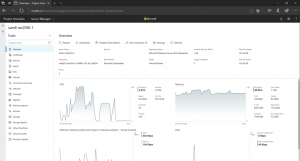
<p>Yesterday Microsoft announced Project &#8220;Honolulu&#8221;, a new way to manage Windows systems through a new shell, this time a Web-based administration shell. I had the privilege to contribute to the design and testing of the tool and I will try to describe why I loved it and why it can become very relevant for Windows sys admins.</p>
What Honolulu is
<p>Honolulu is a Web-based Server Manager that can be installed on both desktop and server machines and provide access, that is to say &#8220;graphical access&#8221;, to one or more servers in your environment. The first thing to notice is that Honolulu doesn&#8217;t require anything &#8220;more&#8221; [...]<img src="https://stats1.vaisulweb.cloud/piwik.php?idsite=1&amp;rec=1&amp;url=https%3A%2F%2Fwww.theserverside.technology%2F2017%2F09%2F15%2Fsay-hello-to-next-gen-server-manager-microsoft-introduces-project-honolulu%2F%3Fpk_campaign%3Dfeed%26pk_kwd%3Dsay-hello-to-next-gen-server-manager-microsoft-introduces-project-honolulu&amp;action_name=Say%20hello%20to%20next-gen%20Server%20Manager%3A%20Microsoft%20introduces%20project%20%26%238220%3BHonolulu%26%238221%3B&amp;urlref=https%3A%2F%2Fwww.theserverside.technology%2Ffeed%2F" style="border:0;width:0;height:0" width="0" height="0" alt="" /></div>]]></description>
		
					<wfw:commentRss>https://www.theserverside.technology/2017/09/15/say-hello-to-next-gen-server-manager-microsoft-introduces-project-honolulu/?pk_campaign=feed&#038;pk_kwd=say-hello-to-next-gen-server-manager-microsoft-introduces-project-honolulu/feed/</wfw:commentRss>
			<slash:comments>0</slash:comments>
		
		
		<enclosure url="https://www.theserverside.technology/wp-content/uploads/2017/09/Project-Honolulu2.png" length="104816" type="image/jpg" />
<media:content xmlns:media="http://search.yahoo.com/mrss/" url="https://www.theserverside.technology/wp-content/uploads/2017/09/Project-Honolulu2-300x161.png" width="300" height="161" medium="image" type="image/jpeg">
	<media:copyright>The Server Side Technology</media:copyright>
	<media:title></media:title>
	<media:description type="html"><![CDATA[]]></media:description>
</media:content>
<media:thumbnail xmlns:media="http://search.yahoo.com/mrss/" url="https://www.theserverside.technology/wp-content/uploads/2017/09/Project-Honolulu2-300x161.png" width="300" height="161" />
	</item>
	</channel>
</rss>
